Let's talk about a country of great interest.. a country with a budget deficit nearing 40 billion dollars in 2026.. and expected to maintain the same deficit in 2027.. then rising to 42 billion dollars in 2028.. and despite that, it conducts massive defense purchases.. numbers that surpass countries like Italy and Poland.. and if we look at its armament, we will find a very strange and interesting mix of Russian systems with Chinese ammunition and South African air defense..
Algeria..
What we need to understand before we take a look at the numbers is that the army in Algeria is not just a military institution.. rather, it is an essential part of the political system itself.. Algeria's history since independence is filled with moments where the military has been the actual ruling power or at least the last guarantor for the continuation of the regime..
With a direct regional competitor like Morocco (and relations have been severed since 2021), military spending has become both an internal and external concern at the same time.. that is, weapons here are not just a means of strategic deterrence, but also a way to buy internal stability and solidify alliances within the ruling elite..
Morocco, for Algeria, is not just a neighbor.. but can be viewed as a military and political mirror for Algeria.. Any arms deal Algeria makes is interpreted in Morocco as an intention to deter it.. and vice versa.. especially with the Western Sahara file remaining open without a final solution..
This has created a kind of dynamics of a silent arms race.. increasing Algeria's air and defense capabilities.. which drives Morocco to consider enhancing its capabilities in the field of drones, air defense, and American armaments.. even if part of this is still under discussion.. and this puts us in a naturally vicious circle.. once you enter it, you find yourself forced to continue in it even if both sides are losing.. I previously explained this in a video titled The Relationship Between War and the Chicken..
Algeria has doubled its defense spending as a percentage of GDP from about 4% in 2022 to nearly 9% in 2025.. and this spending exceeds even Russia’s spending during war, where it spends about 7.2% of its GDP on defense..
The defense budget reached about 25 billion dollars in 2025, after being 21 billion dollars before that, and there is no indication that it will decrease soon.
If calculated according to purchasing power parity (PPP), this defense spending amounts to about 75 billion dollars in local purchasing power, a figure that places Algeria at a higher purchasing level than countries like Italy and Poland, for example.
Well, let’s take a look at the Algerian army..
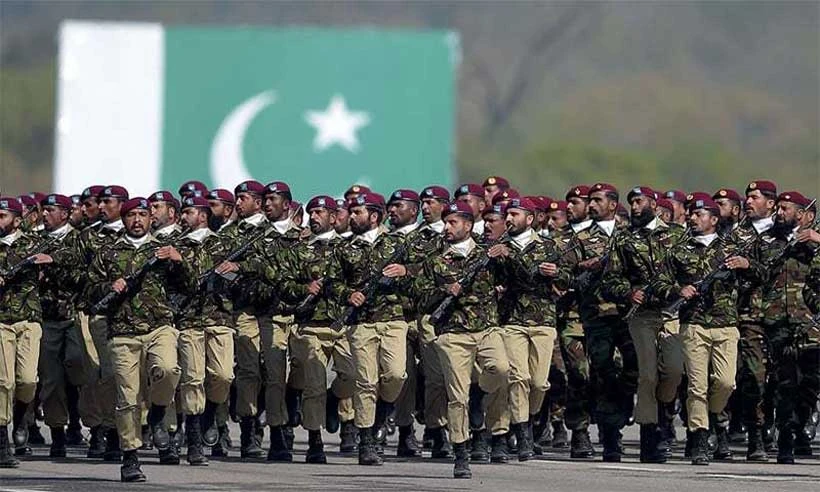
The army includes about 110,000 recruits, around 1,500 tanks, 1,000 infantry fighting vehicles (IFV), more than 1,000 armored personnel carriers (APC), 180 rocket launchers, and over 600 artillery pieces.
The main tank in service is the T-90SA, alongside updated versions of the T-72. Interestingly, there are about 270 old T-55 tanks still in service, but they are currently used in fire support roles, meaning they are no longer part of the modern tank forces.
From this discussion, we can note that Algeria has a clear inclination to purchase or at least prefer somewhat specialized and strange Russian designs compared to traditional arms lines in other countries, such as TOS-1A and BMPT Terminator, which are not widely used even among traditional customers of Russian arms.
This gives the impression that Algerian military thinking is not limited to mere show of force, but focuses on equipping forces capable of imposing heavy fire in complex ground engagements. That is, we are dealing with an army that thinks in terms of combat scenarios between regular forces, not just in counter-insurgency missions.
Algeria is not just an important arms customer; it also has local innovations worth discussing.
One interesting thing is that they started transforming old tank structures like the T-62 into fire support armored vehicles and engineering vehicles, with some fitted with the BMP-2 Berezhok turret equipped with a 30 mm cannon, grenade launchers, and anti-tank missiles.
This means there is practical thinking based on maximizing resource utilization, so rather than leaving old equipment in storage, they are repurposed at a low cost to increase fire density on the ground.
Although Russia is the main supplier, diversification in suppliers exists and is not a simple matter.
For example, Algeria has about 600 German Fuchs vehicles, with some sources indicating an agreement to assemble or manufacture them locally in collaboration with Rheinmetall, with a clear condition prohibiting resale, meaning what is assembled in Algeria remains allocated solely to Algerian forces, and not for export.
In terms of artillery, we see a mix that combines old Soviet heritage with modern Chinese systems of 155 mm caliber.
The Algerian navy includes German frigates with hybrid armament; Swedish missiles, and South African air defense, along with Chinese ships equipped with European radars.
As for air defense, this is a completely different file.
The Algerian system is exceptionally heavy, including systems like S-300, Buk, Tor, Osa, and Strela, in addition to upgraded Pantsir systems that arrived in Algeria before they entered service in Russia itself.
The emergence of the S-400 system above all this means that Algerian airspace is considered one of the most guarded airspaces in Africa, and perhaps in the entire Mediterranean region.
Algeria is one of the very few countries in the world that possesses modern tactical ballistic missiles of the Iskander type, with the export version having a range of about 280 kilometers, and estimates suggest that Algeria has at least 12 launch platforms and around 75 missiles.
The Algerian navy has the capacity to execute long-range attacks from underwater, as the upgraded Kilo submarines can launch Klub-S cruise missiles, opening the door for precise strikes outside the coastal range.
And although Algeria is not a major amphibious force, it can carry out limited landing operations. It has an Italian amphibious ship, the San Giorgio, that entered service in 2015, in addition to two older ships, and these ships can transport a battalion-sized force including tanks and combat support vehicles.
The air force is considered the backbone of the Algerian army, as it possesses about sixty Su-30 aircraft, along with very strong aerial refueling capabilities, thanks to having six Il-78 aircraft, a number that exceeds what some major European countries possess. Its airlift capabilities are varied between Russian Il-76 and American C-130 aircraft.
In 2024, Russia announced that the first export contract for the Su-57E fighter had been signed with Algeria, and Algerian reports indicate that there are ongoing training for pilots and a potential delivery of aircraft by the end of 2025. If this materializes, Algeria will be the first African country to possess a fifth-generation fighter.
By the way, indications have emerged that the Su-35 aircraft, which were initially designated for Egypt before the deal was canceled, have reached Algeria. These reports are based on satellite images and indications from the Algerian air force itself.
With all this, the question remains: Where is the core problem for Algeria?
The answer is one word: sustainability..
Algeria's nominal GDP is about 288 billion dollars in 2025, while its value based on purchasing power is 874 billion dollars. When the primary source of funding is energy revenues, and with a youth unemployment rate of about 30%, very high defense spending turns into an open bet on gas and oil prices.
Any strong fluctuation in these prices can create a gap between the size of the army and the economy’s capacity for maintenance, operation, and continuous upgrading. Then, the risk is not only that the army weakens, but that it turns into an advanced fleet in form, costly in operation, and politically difficult for any government to downsize.
Much of this spending leaks abroad because local manufacturing is still limited. Countries that build their defense industries recover part of the funds in the form of jobs, expertise, and technology, while Algeria is still paying a heavy armament bill without equivalent industrial gains. This simply means that every modernization cycle must be funded anew and in hard currency, with the risk of facing sanctions, restrictions, or disruptions in supplies.
We cannot ignore another very sensitive point.. which is that Russia itself is at war, and any advanced aircraft or system it exports to Algeria is a system that does not enter into the stocks of the Russian army, which has huge needs. This means there is a risk of delivery delays, or the possibility that Russian internal priorities may suddenly take precedence at the expense of the customer. Hence, diversifying arms sources in the future is not a luxury but a strategic necessity.
Interestingly, Algeria did not enter 2022 as a weak army needing urgent development, but was already one of the most equipped armies in Africa: Modern tanks, multi-layered air defense, Kilo submarines armed with cruise missiles, and a strong air force with extended range thanks to aerial refueling capabilities.
So, what happened after 2022 was not a beginning of armament, but an acceleration of a pace that was already high, an acceleration closer in speed to wartime economy logic in peacetime.
Thus, the difficult question that Algeria needs to answer remains:
Can the economy continue on this trajectory? Or will a moment come when the commitments exceed the ability to bear? And what is the plan then?
This is an AI-generated English translation. The original text is in العربية
PhD Researcher in Defense Contracting and Cooperation Policies