
When did the discussion about the relationship between technology and war begin?
And what is the difference between technology and strategy?
And how can we think philosophically in a world where strategic thinking is distributed among humans, algorithms, and technological systems?
Before attempting to answer these questions, or rather, before opening the doors to understanding the answers to these questions, it is better to tell a very short story.
On my first day talking to my doctoral supervisor, he gave me advice: If you want to specialize deeply in a particular field, you must understand the history of that subject philosophically, and know where this philosophical history came from. Since that day, I've been lost amid discussions of the kind that require a long time to understand, and every time I read it again, I found that I understood a new part that I had not noticed before.
Today's post is different and a bit heavier than what we are used to. It is the result of academic research; I took my understanding of the subject and my observations on it, and then tried to simplify it as much as possible, believing that sharing it may help in understanding the philosophical history of wars and technology.
...
The geopolitical scene we live in today forces us to think about strategy and technology much more deeply than merely following the news of wars that come to us daily through the media.
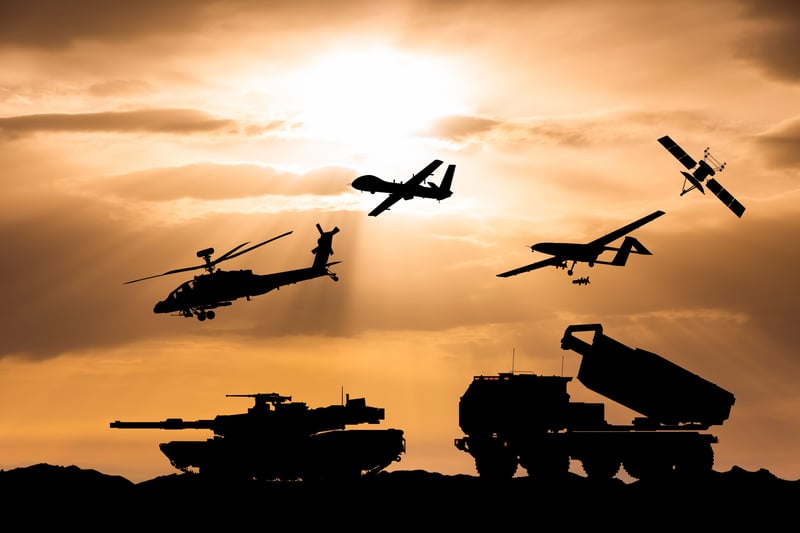
For the scene is not just tanks and missiles and open fronts, but there is a slow and continuous militarization of society itself, and a transformation of the tools of governance, management, and economics into part of the logic of conflict.
New patterns of war emerge with every technological wave, patterns whose primary goal is not merely to destroy the material capabilities of the opponent, but has a more important goal: to manipulate the way the opponent understands the world, and their fundamental concepts.
The traditional boundaries between civilian and military, and between war and peace, start to dissolve and intermingle, until they reach a degree where distinguishing between them becomes extremely difficult.
The history of wars in the world is essentially a history of technologies; every major technological shift either turned the balance of power or changed the nature of war itself. It can also be understood that these technological shifts were a cause of the wars themselves, if we want to exaggerate the explanation.
You have light rifles, then another party invents heavy artillery; they test it against you and seize your land and resources as long as this is a new technology that is not available to you. Think about it from gunpowder to the atomic bomb that made the idea of total annihilation a realistic possibility, not just dreams for colonial countries; all are technologies born from wars, but they also created wars.
And despite the deep relationship between technology and wars, the classical philosophical heritage often treats war and technology as margins. Even today, we do not possess enough intellectual tools to truly understand the stage we are going through.
Technology and strategy can be seen not as separate fields, but as a single historically extended line, always moving in a shared gray area between them. Traditional philosophy placed them outside the center under the pretext that they are means, not ends, and that they deal with emergencies, not with fixed principles, thereby assigning them a secondary role in the larger picture.
But if we take a step back, we will find that the relationship between them (technology and strategy) is much older and deeper.
In ancient Greece, the word techne was associated with the idea of metis, which means cunning, cleverness, and guile as tools for thinking and action.
The critical thought in the modern era saw this alliance as a complete strategy for domination, not just neutral tools, but even this reading sometimes confines strategy to the logic of control alone, as if there is only one model: a party that knows everything and pulls the strings from above, while the others are just puppets moving according to these strings.
The problem with reducing strategy to the idea of control overlooks its essential nature, which is dealing with an environment that is inherently unstable, not fully understood, and often hostile.
In contrast to any beautiful philosophical dream about truth, governance, and peace that is always presented to us as supreme values, an important reality emerges: the stability of these values on the ground always depends on precise technological and strategic arrangements.
The language that redefines reality, or the use of calculated violence, or the ideological camouflage of completely material power relations; all are examples that affirm that strategy is not an intellectual luxury, but a recognition that thinking itself always operates on shaky ground, filled with elements that cannot be fully grasped.
If we move to one of the deepest philosophical reflections on the concept of strategy, the name Clausewitz must appear before us; for he insisted on the separation of technical activity from strategic activity.
He said that the architect, for example, applies mechanical processes to a passive raw material that does not react; in other words, he has a clear model, fixed laws, and a reality on which he works without the reality itself responding back to him.
But in war, the image is exactly the opposite; the opponent is a rational entity that changes its tactics, and the reality itself moves quickly, and thus any attempt to treat war as a mechanical sport or as fixed equations fails from the very first moment.
Clausewitz sees that the knowledge of the strategist should also be dynamic; knowledge that works on the logic of continuous transformation, re-evaluation, and adaptation to a hostile goal that moves all the time.
This is what led him to reject the idea of "the art of war" in the easy concept that likens war to fine arts or traditional crafts aimed at shaping a dormant raw material.
For the goal in war is a living being, and its reaction is part of the equation itself; and if you keep thinking of war as an art that shapes an inert material, you will always live in an illusion.
But the history of thought and technology did not stop at this moment of separation. One of the most important historical responses to the problem that techne deals with something inert was the emergence of cybernetics.
Cybernetics entered with a simple and dangerous idea at the same time: instead of looking at the machine as a device carrying out fixed orders on a static reality, it is viewed as a system that receives signals from reality and continuously readjusts itself based on feedback coming from the target.
A scientist named Norbert Wiener worked on the concept of "negative feedback" during World War II, and a clear example of this shift was the development of technological systems capable of adjusting themselves momentarily based on signals coming from the target they deal with, a development that ultimately led us to drones and autonomous systems.
At this moment, technology and strategy returned to being friends more clearly; for we now have technological systems originally designed by strategic logic, thinking of the enemy as a variable, of the target as an entity that responds and moves, and of the technological act itself as part of an ongoing cycle, not a single step.
This means that techne is no longer just a blunt tool; it has become part of a network of adaptation and response, and at the same time, it opened the door to deeper questions: If the machine itself has become part of the logic of feedback, where does human decision begin and where does it end? And how can we think philosophically in a world where the strategic mind is distributed among humans, algorithms, and technological systems?
The essential point here is not only that war has changed, but that our understanding of the relationship between thought, technology, and strategy needs to be rebuilt anew.
Without intellectual tools that grasp that we live in a hybrid environment where the civilian mixes with the military, and where technology is not neutral and not merely a means, our analysis will remain insufficient to understand the nature of the conflicts forming before us today.
This is an AI-generated English translation. The original text is in العربية
PhD Researcher in Defense Contracting and Cooperation Policies